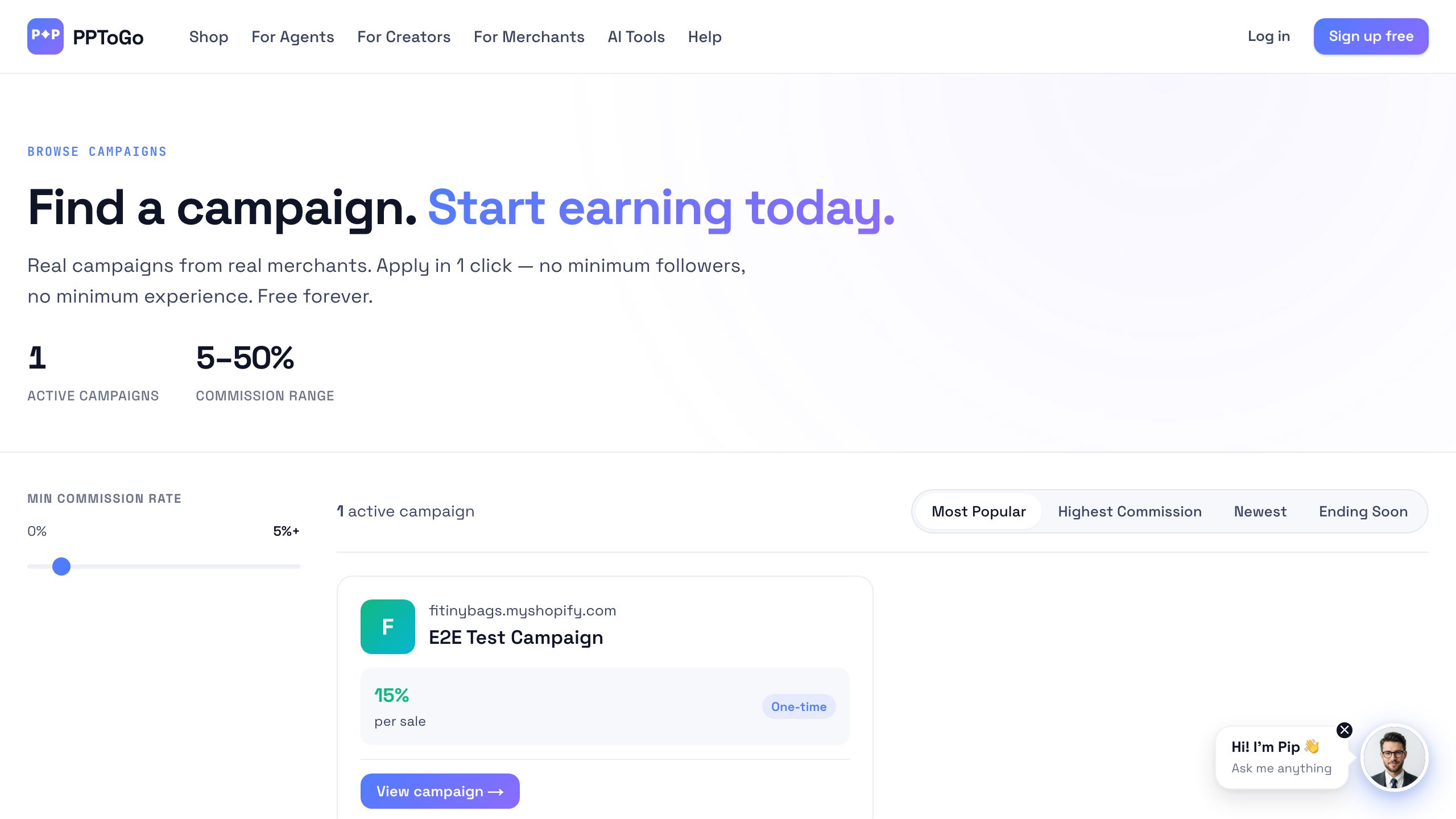
We've watched six months of campaign applications since PPToGo opened to merchants. Most campaigns underperform for the same three reasons. This post is the playbook we wish every new merchant ran by us before launching their first campaign.
The thing that doesn't work
The intuitive move is: “our default commission is 15%, we want this campaign to feel premium, so let's offer 20%.” Five percent above default. Premium-looking.
Almost nobody claims those campaigns. The application rate sits roughly the same as the default rate would have produced — about 2 to 4 creators per week for a mid-sized catalog. The creators who do apply tend to be the lowest tiers, because the higher tiers are doing math on opportunity cost and a 5-point bump isn't worth their attention.
Rule 1 — Either 5x your baseline or explicitly signal tier-up
Two patterns work. The first is the brute-force rate hike: campaign rate at least 5x the category baseline. For fitiny's 20% default, that's a 100% campaign — which sounds insane until you remember it's only on the products inside the campaign, for the campaign window, and PPToGo nets out refunds before payout. Use this for clearance, new launches, or anything you'd otherwise discount heavily.
The second pattern is subtler: keep the rate modest but explicitly offer tier-up signaling. Bake into the campaign brief that “creators who drive 5+ conversions during this campaign receive a fast-track to gold-tier consideration.” The trust scorer respects merchant endorsements, and creators chase tier graduation events. We've seen application rates triple on campaigns that did this.
campaigns.commissionRate column must be at least equal to the merchant's defaultCommissionRate. We reject lower values at insert time — creators should never find themselves earning less on a campaign than they would organically.Rule 2 — Time-box the campaign to 2–4 weeks
The single biggest predictor of campaign application volume is the date window. Two to four weeks works. Anything shorter feels like a stunt (and creators don't want to invest content production into a 5-day window). Anything longer reads as evergreen, which means there's no urgency to apply now.
Practical example from a suumee campaign on home goods: same commission rate, same product set, two different window lengths. The 14-day version pulled 31 applications. The 90-day version pulled 8.
Rule 3 — Don't open to all tiers
This is counterintuitive. The form lets you set a minimum creator tier (new, bronze, silver, gold, or platinum). The instinct is to leave it at new to maximize the funnel.
Bad instinct. When you require silver-or-higher, application rates jump roughly 3x against the same campaign run open. The creators interpret the gate as pre-validation — “this merchant cares about quality, and being eligible means they think I'm quality.” That perception is worth more than the marginal applicant you'd have gotten from new-tier creators who were going to bounce anyway.
If you genuinely want to reach new creators, run a separate new-only campaign at a slightly lower rate. Don't mix tiers in one offer.
Putting it together — an actual brief
Here's the structure of a campaign brief that consistently pulls more applications than the creator marketplace can absorb:
Name:           Pearl Set Summer Launch
Product set:    All SKUs tagged "summer-2026-pearls" (12 products)
Commission:     35%  (default is 20%, so this is 1.75x — barely
                acceptable; we'd actually push to 40% in retrospect)
Window:         21 days
Minimum tier:   silver
Tier-up bonus:  "5+ conversions during this campaign fast-tracks
                creator to gold-tier consideration"
Content notes:  "Must show the product worn, not flat-lay. We will
                feature top 3 performers on our IG main."
Refund policy:  30-day buyer refund window honored; creator refund-
                rate impact: standard.
Things to avoid
- Vague briefs. “Talk about how much you love the product” pulls applications from people who don't care. Specific direction (“show in natural light, mention the clasp mechanism”) pulls applications from people who've actually held the product.
- Stacking exclusivity clauses. If you require a creator not to promote competing brands during the campaign, you will lose every gold/platinum applicant. They have established relationships with other merchants and they won't risk them.
- Hidden requirements. If you want IG main feed posts, say so up front. Surprising creators with format requirements at the approval stage is the fastest way to get downvoted in the public campaign reviews on /campaigns.
What the data says
Looking at the top quartile of campaigns by application rate across Q1 2026:
- Median commission rate: 3.4x the merchant's default.
- Median window: 18 days.
- Tier-gated: 72% required silver or above.
- Brief length: median 147 words. Detailed but not novel-length.
Next steps
- Create your first campaign at
/dashboard/merchant/campaigns/new. - Watch what other merchants are running at /campaigns.
- If you haven't installed the Shopify app yet, start at /api/shopify/install.